
What is popping?
Popping originated in African-American culture in California in the 1970s and became one of the most recognisable styles in street dance. For a deeper background, you can read more about the history of popping in our separate article.
The foundation of popping lies in ‘hits’ and ‘pops’, where dancers quickly tense and relax their muscles to create sharp, rhythmic accents. What makes popping so unique is the way it combines precision, musicality and illusion. Elements such as waving, gliding, strobing and animation can make the body look robotic, fluid, unreal or effortless.
In this article, you will learn what popping is, what makes it unique, which elements belong to the style and how beginners can start learning it.
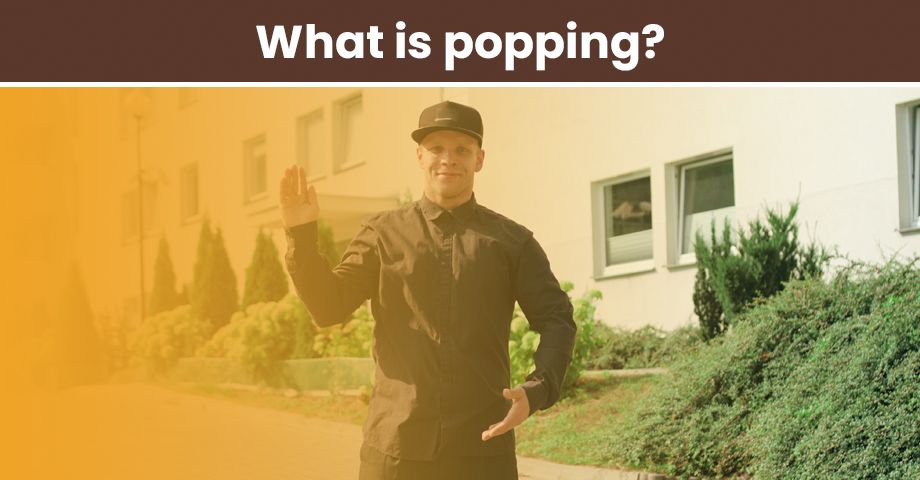
What is popping?

Popping is a dance style based on quickly tensing and relaxing different parts of the body. These muscle contractions are called ‘hits’ or ‘pops’ and are used to accent the music, especially the strong beats in funk.
The style also includes many other elements, such as waving, gliding, strobing and animation. This gives popping a wide range of movement possibilities. Sometimes it looks mechanical and robotic, while at other times it can look smooth, fluid or unreal.
In the 1970s, popping was mainly danced to funk music. Today, it is also performed to hip hop, electronic music and many other genres.

What makes popping unique?

Popping is unique because it has a visual quality that is hard to find in any other dance style. The movements are precise, controlled and deeply musical.
Many dance styles focus on continuous flow and groove. In popping, dancers often isolate different parts of the body and move them independently. A good popper can make complex movements look effortless, but every detail takes hours of training.
Popping is not only sharp and detailed. It can also be smooth and fluid through elements like body waves and glides. This contrast between sharp ‘hits’ and smooth transitions gives popping its special balance between explosiveness and flow.
The creativity in popping is also a huge part of the style. Poppers often use characters, storytelling and visual illusions to express themselves. They do not just follow the beat, they listen deeply to the music and respond to different layers, sounds and rhythms.
The main elements of popping

As mentioned earlier, ‘hits’ and ‘pops’ form the foundation of popping. But the style is much more diverse than that. Popping includes many techniques and sub-styles that give dancers a wide range of ways to move, create and express themselves.
Waving
Waving is when you move different body parts one after another to create the illusion of a wave travelling through your body. This can be done with the arms, torso, legs or almost any other body part.
Animation
Animation is a technique where dancers move in an unreal or cartoon-like way. It often uses pauses, exaggerated movements and unusual timing to create an animated effect.
Tutting
Tutting involves creating sharp angles and geometric shapes with the arms, hands and fingers. These shapes change in patterns, almost like moving architecture.
Robot
Robot is one of the most recognisable elements of popping. Dancers use pauses, isolations and mechanical movements to create the illusion of moving like a machine.
Gliding
Gliding makes it look like the dancer is floating across the floor. This is done by carefully shifting weight and using the heels and toes to create a smooth sliding effect.
Isolations
Isolations involve moving one body part independently from the rest of the body. For example, a dancer might move one arm while keeping the rest of the body still, or move two body parts in completely different ways.
Bringing it all together
Together, these elements show how much creative freedom there is in popping. The style can be sharp, smooth, robotic, animated, fluid or completely unreal.
Musicality in popping

Poppers are true specialists when it comes to musicality. They do not only dance to the beat, but also to the different layers inside the music.
A popper might follow the bassline, hit sharp accents in the percussion, react to a vocal, or move smoothly with the melody. Through their movement, they show the audience what they hear in the music.
That is why rhythm and timing are so important in popping. Sharp hits, sudden pauses and smooth transitions all need to connect clearly to the sound. The better a dancer understands the music, the more detail, feeling and expression they can bring into their popping.
Popping versus other dance styles

Popping is part of the wider world of street dance and is often seen in dance battles, performances and group choreographies. Because it is sometimes performed alongside styles like hip hop, breaking and locking, it is easy to confuse them. Still, popping has its own techniques, background and culture.
Popping vs breaking
Breaking is an explosive dance style with energetic steps, floorwork and athletic movements. Its main elements include toprock, footwork, power moves and freezes. Popping, on the other hand, focuses more on muscle contractions, precision, timing and body control.
Breaking originated in New York, while popping developed in California. They look very different, but they do have one thing in common: both styles take a lot of patience and practice to learn well.
Popping vs hip hop dance
Hip hop dance is built around social party steps, grooves, bounce, rhythm and freestyle movement. It is closely connected to hip hop music and culture. Popping, however, developed mainly from funk music and focuses more on hits, animation, isolations and detailed body control.
Many people also think animation is a separate dance style. In reality, animation is usually seen as part of popping. It uses techniques such as pauses, strobing, slow motion and character work. A strong popper can combine animation with hits, waves, glides, tutting and other techniques to create a full range of expression.
Popping vs locking
Popping and locking are often confused because their names sound similar. Some people even use the term ‘pop-locking’, but this is not really correct and is often laughed about within the street dance community.
Locking is playful, energetic and expressive. It often includes points, wrist rolls, claps, big gestures and strong audience interaction. Popping is more focused on muscle contractions, waves, animation, gliding, storytelling and precise control.
Both styles developed in California and are connected to funk music, but they are two different dance styles with their own techniques, feeling and culture.
Popping culture and freestyle

Popping started as a freestyle dance. This means dancers improvise in the moment and respond to the music, the space and the people around them.
Over time, popping also became popular in choreography and performances. Choreography can be useful for drilling technique and learning new movements, but freestyle remains a big part of the culture. It gives dancers the freedom to express their own style, ideas and interpretation of the music.
Freestyle is often practised in cyphers. A cypher is a circle of dancers where people take turns dancing in the centre. It is a place to share ideas, learn from each other and exchange energy. Sometimes battles happen inside cyphers, either to challenge someone or to show respect.
Originality is very important in popping. Dancers are encouraged to learn the foundations first, then use them to create their own variations. Copying another dancer’s moves or style without adding anything personal is called ‘biting’, and it is not respected in the popping community.
Is popping hard to learn?

Popping is not the easiest dance style to learn. To pop well, you need timing, coordination and strong body control. You often have to do several things at once, such as hitting with one body part, moving another and staying connected to the music.
Many beginners can learn basic ‘hits’ and ‘pops’ quite quickly, but doing them cleanly and in time with the music takes much longer. The key is to practise consistently and not expect instant results. Popping is a marathon, not a sprint.
When beginners watch popping, they often notice the impressive moves first, such as gliding, animation and complex tutting combinations. These moves look exciting, but the basics should come first. Clean hits, timing, grooves and body control will take you much further in the long run. Once those foundations are strong, the more advanced tricks become much easier to learn.
Beginner tips for popping

Start with the basics: learn the ‘pops’ and ‘hits’ first. Once you can tense and relax different muscles in time with the music, popping becomes much more enjoyable. Online dance platforms like MyGrooveGuide can help with simple drills, basic hits and easy popping patterns you can practise anywhere.
Practise slowly before trying to go fast. When you move too quickly, it is easier to hide weak technique. Slow practice forces you to understand the mechanics of each movement and helps you build cleaner control. Once your technique improves, you can gradually increase the speed while keeping the movement sharp and accurate.
It also helps to learn about the history of popping. Understanding where the style comes from gives you a better feel for its culture, music and movement. Since popping developed from funk music, listening to funk is a great way to understand the bounce, rhythm and energy of the style.
Finally, focus on control and cleanliness. Sharp hits, clear shapes and smooth transitions will always have more impact than complicated tricks done messily.
Popping today

Popping is now bigger and more accessible than ever. You can find it all over the world, from online freestyle videos to major battles, underground jams, concert choreographies and music videos.
Social media has played a huge role in this growth. Platforms like TikTok, Instagram and YouTube have made it easier to discover popping, watch tutorials and connect with dancers from different countries. What started on the streets of California has now become a global dance style.
Today, poppers from every continent connect online and in real life through battles, jams, workshops and community events. Online dance platforms such as MyGrooveGuide also make it easier for beginners to start learning popping and grow into confident dancers.
Conclusion

What began as a funk-inspired dance style in California has grown into a worldwide culture practised in battles, performances, choreography and jam sessions. With its sharp muscle contractions, smooth movement and creative interpretation, popping can make the body look like a visual illusion.
For anyone interested in learning popping, the best place to start is with the foundations. Focus on clean hits, timing, groove and body control before moving on to more advanced techniques. With guidance from MyGrooveGuide, you can build your skills step by step and grow from a beginner into a confident dancer. Check out our overview of classes.
Structured Hip Hop Classes That Build Confidence.
Boost your rhythm and technique with step-by-step classes from world-class hip hop instructors.
Get started