
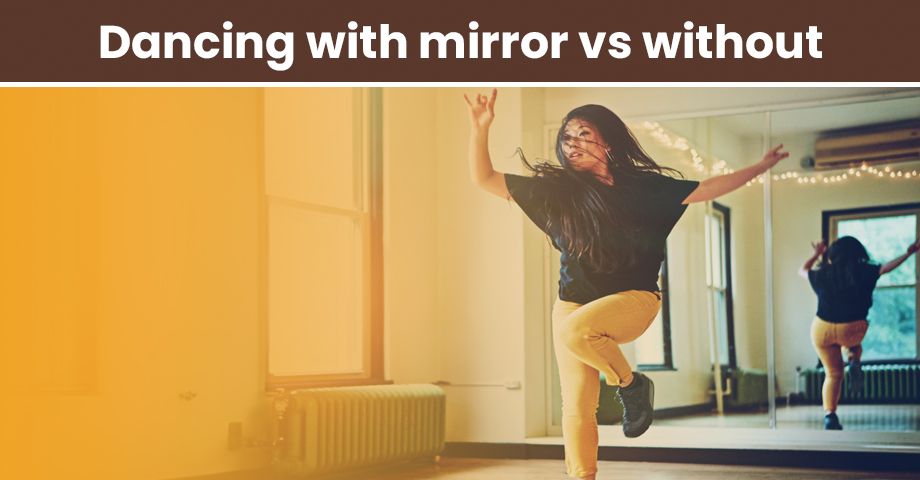
Dancing with a mirror or without a mirror?
Dancers get asked this all the time: do you train with a mirror or without a mirror? And if you teach, should you use the mirror or not? Everyone has an opinion, but the real answer is less dramatic. Both options can help you, and both can mess with your progress if you only stick to one.
The trick is knowing when the mirror is useful, and when it’s better to turn away and dance from feeling. In this article, you’ll learn when to train with a mirror, when to ditch it, how filming compares, and how to find the right balance for choreography, technique, freestyle, and performance practice.
Why dancers use mirrors
Mirrors are popular for one simple reason: instant feedback. Dancing without a mirror can feel amazing, but that doesn’t always mean it looks how you think it does. In the mirror you can see your shapes, angles, and posture straight away. That makes it easier to fix small details on the spot, like alignment, lines, and placement, which helps you look cleaner faster.
Mirrors are also useful for choreography, especially in groups. You can quickly check if you’re on the same timing as everyone else, and whether your spacing in the formation is right. The only thing a front mirror can’t show well is depth, how far forward or back you are, so sometimes you still need a side view or someone to watch.
For teachers, mirrors make class smoother too. You can face the mirror, teach with your back to the room, and students can copy you directly. At the same time, you can scan the whole class in the reflection and spot who needs a correction. That’s why mirrors work so well for group timing, formations, and clean choreography.
Benefits of training with a mirror

If you use it in the right way, a mirror can speed up your progress because you get instant feedback and can clean things up on the spot:
- You correct technical mistakes faster.
- Your symmetry, lines, and posture become cleaner and more precise.
- You build body awareness faster, especially as a beginner.
- It helps with learning choreography and rehearsing performances.
- Group timing and synchronisation improve.
- As a teacher, you can keep a clear overview of the whole class.
- Your overall presentation, spacing, and timing become stronger.
Used well, the mirror is one of the quickest ways to polish your dancing, especially for choreography. Even in freestyle-heavy styles, it’s still a useful tool for quick technique checks and clean shapes.

Drawbacks of training with a mirror
Using a mirror has real benefits, but you don’t want to become dependent on it. Some dancers train with a mirror so often that they feel lost when it’s gone. The mirror helps with synchronisation, timing, spacing, and formation placement, but you won’t have one on stage. That’s why many dancers and crews cover the mirrors during the final rehearsals, so the performance feels more realistic.
Another downside is constant self-correction. If you keep checking the mirror to match the teacher or compare yourself to others, your movement can become tense and less natural. Musicality, expression, rhythm, and groove can start to disappear, and confidence can take a hit. A mirror should stay a tool, not a requirement. Try practising at home without one, and in class, challenge yourself to look away sometimes. If you still want visual feedback, film a round, watch it back, and apply the notes in your next run.
Check this video for more info on how to freestyle without a mirror:
Benefits of training without a mirror

Dancing without a mirror can feel harder at first, because you lose that instant visual check. But once you learn to stay aware of your body without looking, you build a much deeper connection to your movement. Without visual feedback, you’re forced to sense where your body is in space, and that improves control, balance, and body awareness. This is proprioception, and it’s what helps build strong muscle memory, so your body can repeat movements reliably.
Training without a mirror also strengthens your connection to the music. You have to trust feeling instead of watching yourself, and that often brings out more confidence and more natural expression. Over time, rhythm, groove, creativity, and personal style tend to grow faster when you spend real time without the mirror. The sweet spot is balance. Use both methods, and switch depending on your goal, rather than doing only one all the time.
Drawbacks of training without a mirror
Dancing without a mirror can really boost your development, but it also comes with challenges. The biggest one is alignment. When you learn new techniques without visual feedback, it’s easier to miss small things like posture, lines, angles, and where your weight is placed. If those details slip for too long, your overall movement quality can suffer.
Progress can also feel slower at first. Without a mirror, you rely more on feeling and on outside feedback, for example from your teacher or training partners. Filming your dancing is a great middle ground. You still train without looking at yourself in the moment, but you can review the video afterwards and make corrections in the next round. That process may take a bit longer, but it builds real awareness and keeps you from depending on the mirror.
The only risky route is no feedback at all, meaning no mirror and no video review. That can lead to repeating mistakes until they become habits. If you drill something the wrong way, it can take much longer to undo later. The best approach is to use the mirror to learn and check key details, then spend time away from it to build control, confidence, and independence.
Mirror vs camera training

When you use a mirror, you get instant feedback. You can adjust posture, placement, technique, and timing while you’re still moving, which is especially useful for group synchronisation. The downside is that it’s easy to start relying on it. On stage you won’t have a mirror, so your training needs to include moments where you perform without one.
That’s where a camera beats the mirror. When you watch a recording, you’re not busy dancing, so you can observe with more focus. You also see what the audience actually sees, which makes it easier to judge your overall presentation, expression, spacing, and how you come across as a performer.
A great habit is to switch the mirror for a camera regularly. Train the material without looking, film a run, then review and make clear notes for the next round. Video feedback helps you grow without becoming mirror-dependent, and it’s one of the best tools for long-term progress.
When to use the mirror

The mirror is most useful when you want quick, clear feedback on specific things. Here are the moments where it really helps:
- Learning new choreography
- Fixing lines and posture
- Technical drills for placement, control, and clean shapes
- Group synchronisation and timing
- Formations, spacing, and positioning in the room
- Dancing more unified as a group
- Refining technique and precision
- Giving teachers a clear overview of the class
Use the mirror for these purposes, but keep it a tool, not a crutch. If you feel like you need the mirror to dance, you’re starting to rely on it too much. You want to be able to perform without it, and you want to trust your body and your feeling just as much as your eyes.
When to use no mirror
There are also moments where the mirror can get in the way. Taking it out helps you train from feeling, build confidence, and prepare for real performance situations. Here are the best times to use no mirror in your dancing:
- During freestyle practice, so you focus on feeling, creativity, and personal expression
- During musicality training, so you lock into rhythm, groove, and timing
- During performance run-throughs and dance battle practice, because that’s how it will be in real life
- When you want stronger stage presence, projecting energy outward and connecting with the audience
- When you want to build independence, stronger performance quality, and a more genuine vibe
In short, dancing without a mirror helps you become a more confident performer, not just a clean mover. The mirror is great for technique and synchronisation, but stepping away from it is what builds trust in your body and your own expression.
Finding the right balance

The main point is balance. Training with a mirror and training without a mirror both help, but sticking to only one can limit you. If you always use a mirror, you may struggle when it’s gone. If you never use one, you might miss important details in posture, lines, and placement. You want to be able to dance well in any room, with or without a mirror.
A simple approach is the 50/50 split many dancers use in class. Start with the mirror to learn choreography or clean technique. Then remove it halfway through and run the same material from memory and feeling. That switch builds confidence, body awareness, and control, and it prepares you for real performance situations.
Your balance should also change as you level up. In the beginning, the mirror can help you learn basics faster and understand shapes. As you gain experience, you can rely more on internal feeling, musicality, and performance quality. When you use both methods on purpose, you build clean technique and stronger stage presence, without losing your own style.
Watch this video of how dancers create amazing choreography by using mirrors to their advantage:
Conclusion

In the end, training only with a mirror isn’t better than training without one, and the other way around. Both methods have real benefits, and both can cause problems if you rely on them too much. What matters is choosing the right option for your goal in that moment.
Use the mirror when you want to clean technique, posture, lines, or group timing. Step away when you want to build confidence, musicality, performance quality, and freedom in your movement. At MyGrooveGuide, we offer structured urban dance classes that help you build technique, musicality, and performance skills step by step, so you can train with or without a mirror and still keep improving. See our overview of classes.
Structured Hip Hop Classes That Build Confidence.
Boost your rhythm and technique with step-by-step classes from world-class hip hop instructors.
Get started